

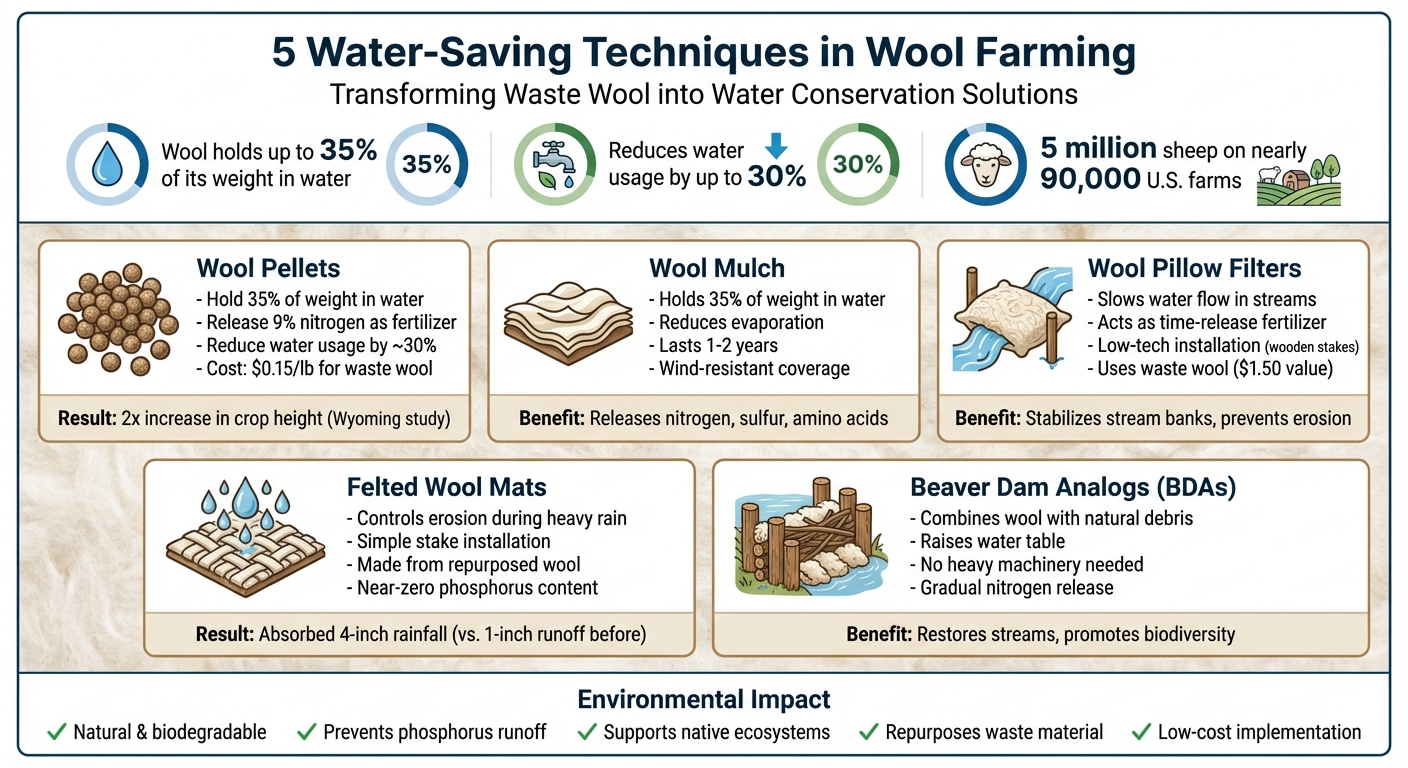
Wool farming in the arid Western U.S. faces water shortages and erosion challenges. However, waste wool - a byproduct often discarded - offers a surprising solution. Wool’s ability to hold up to 35% of its weight in water has led to innovative methods that reduce water usage by up to 30% while improving soil health and stream stability. Here’s how:
- Wool Pellets: Act as natural sponges, releasing moisture and nutrients into the soil, boosting crop growth.
- Wool Mulch: Reduces evaporation and enriches soil, providing a long-lasting moisture barrier.
- Wool Pillow Filters: Slow water flow in streams, preventing erosion and improving soil moisture.
- Felted Wool Mats: Manage water runoff and stabilize soil, even during heavy rains.
- Beaver Dam Analogs (BDAs): Combine wool with natural materials to restore streams and raise water tables.
These simple, cost-effective methods repurpose waste wool into tools that conserve water, improve soil, and support ecosystems, offering practical solutions for farmers dealing with drought and erosion.
5 Wool-Based Water Conservation Techniques for Sustainable Farming
Why Wool is Saving America's Rivers!#WoolRestoration#MontanaRivers#EcoInnovation
1. Using Wool Pellets to Retain Soil Moisture
Wool pellets transform waste wool into small, natural sponges that gradually release moisture into the soil. These pellets not only hold up to 35% of their weight in water, but they also break down over time, releasing around 9% nitrogen to enrich the soil’s structure.
Water Conservation Potential
Wool pellets have the potential to cut water usage in agriculture by about 30%. In 2023, Alicia and Ben Rux of Cottonwood Creek Ranch in Crowheart, Wyoming, tested wool pellets on 16×16 ft plots, applying them at different rates. The results were striking - oats grown in treated plots were twice as tall as those in untreated areas.
"Through our experiment, just applying them to the surface of the ground made a huge impact. The most striking test plot was the oats. There was easily a two-fold increase in height." – Alicia Rux, Co-owner, Cottonwood Creek Wool
Such results suggest wool pellets could offer a simple, scalable solution for farmers.
Ease of Implementation
The process of creating wool pellets starts with processing waste wool through a pellet mill. For small gardens, spreading the pellets by hand works well, while larger farms can use standard equipment like a three-point fertilizer spreader. What makes this even more appealing is the affordability of the raw material - waste wool from sheep’s bellies and hindquarters - which often costs as little as 15 cents per pound.
Environmental Benefits
Wool pellets not only help conserve water but also promote sustainable farming practices. Unlike synthetic fertilizers, which can lead to phosphorus runoff and harmful algae blooms, wool pellets reduce this risk while improving soil health. These pellets are completely natural, renewable, and biodegradable. In the summer of 2024, Robert J. Andrews, Jr. processed 20,000 pounds of waste wool and planned to scale up to 100,000 pounds for his New Liberty Wool Pellets business.
"We have younger farmers getting into agriculture who are more willing to try new things. They're also looking for things that are more sustainable and regenerative. Wool is that." – Robert J. Andrews, Jr., Owner, New Liberty Wool Pellets
2. Applying Wool Mulch to Prevent Water Loss
Wool mulch takes waste wool - those lower-quality fibers from a sheep's belly or hindquarters that textile companies typically discard - and turns it into a tool for conserving water. Farmers apply it by hand, spreading it around plant bases or across fields. This practice not only reduces evaporation but also keeps material out of landfills, giving it a second life as a moisture-retaining solution, especially during dry periods. It works well alongside other water-saving methods mentioned in this article.
Water Conservation Potential
Wool can hold up to 35% of its weight in water. Acting like a sponge, it captures and retains moisture, significantly cutting down on evaporation. By keeping the soil covered, wool mulch helps preserve moisture and even extends the growing season.
"Her wool takes on water and holds it." – Albert Wilde, Sixth-generation Utah sheep rancher
Ease of Implementation
Using wool mulch is straightforward. Farmers simply spread clumps of wool by hand to cover the soil. Unlike lighter materials like straw or wood chips, wool mulch stays put even in windy conditions. It also decomposes slowly - over the course of one to two years - offering benefits that last through multiple growing seasons without the need for frequent reapplication.
Environmental Benefits
Wool mulch does more than conserve water; it also enriches the soil. As it breaks down, it releases nutrients like nitrogen, sulfur, and amino acids, which improve soil fertility while reducing the risk of nutrient runoff that can cause algae blooms. With more than 5 million sheep raised on nearly 90,000 farms across the United States, there’s an abundant supply of waste wool available for this purpose. This process highlights how wool mulch combines practicality with environmental responsibility.
"No one knows wool is a natural, renewable fertilizer. It's about getting people to know." – Alicia Rux, Co-owner, Cottonwood Creek Livestock
3. Installing Wool Pillow Filters in Waterways
Wool pillow filters present an inventive way to manage water flow in creeks and streams on wool farms. These fabric pouches, packed with waste wool, are anchored to creek beds using simple wooden stakes. This method works hand-in-hand with other wool-based water conservation techniques, helping to moderate water flow and maintain soil moisture. By slowing down fast-moving water, these filters allow more water to soak into the surrounding soil rather than rushing downstream. They also help mitigate channel incision, a process where waterways erode deeper into the land, draining valuable moisture away.
Water Conservation Potential
By reducing the speed of water flow, these filters not only help retain moisture but also release beneficial nutrients as they naturally decompose. Wool contains nitrogen, proteins, and amino acids that nourish vegetation along the banks, further stabilizing the soil and improving water retention.
"It's a structural tool that slows the flow of water, and because of wool's high concentration of proteins, amino acids, and nitrogen, it serves as a time-release fertilizer when the creek is dry, prompting plant growth even during dry stretches." – Becky Weed, Sheep Producer
Ease of Implementation
One of the most appealing aspects of this method is its simplicity. No heavy machinery is required. For example, in March 2025, rancher Becky Weed from Belgrade, Montana, installed these filters by securing the wool-filled pillows with wooden stakes. The filters make use of waste wool - typically sourced from sheep bellies and hindquarters - that is usually discarded by textile processors. While shearing this wool costs about $4.50 per sheep, its market value is only around $1.50, making this an economical way to repurpose a low-value material.
"Wool is a low-tech, low-cost technique... At a small scale, it's been very successful." – Becky Weed, Rancher
Environmental Benefits
These filters do more than just manage water flow - they also offer environmental advantages. By stabilizing stream banks, they reduce the risk of bank collapse. Unlike synthetic fertilizers, wool contains almost no phosphorus, which helps prevent nutrient runoff that can cause harmful algae blooms. As the wool decomposes, it supports local ecosystems by encouraging the return of native plants, insects, and birds to healthier, more stable waterways.
sbb-itb-9d397ff
4. Using Felted Wool Mats to Control Erosion
Felted wool mats have joined the lineup of wool-based solutions for managing water and controlling erosion. These mats act as affordable barriers, slowing water flow and preventing soil from washing away. Thanks to wool's natural ability to retain moisture, they also help keep water in the soil rather than letting it run off.
Water Conservation Potential
Wool's moisture-holding properties make these mats especially useful during heavy rain. Take Linda Poole, a sheep producer in Malta, Montana, for example. In March 2025, she installed felted wool mats as part of Beaver Dam Analog structures along a creek on her property. Before using the mats, even a one-inch rainfall would result in water runoff. After installation, her land absorbed a four-inch rainfall without losing water to runoff.
"It used to be that if I got a one-inch rainfall, most of it would run off. Now, I can get a four-inch rainfall and all of it goes into the land." – Linda Poole, Sheep Producer
Ease of Implementation
One of the best parts about using wool mats is how simple and affordable they are to implement. Farmers can easily secure the mats to stream beds or eroding banks with wooden stakes. Unlike traditional stream restoration methods that require heavy machinery and significant investment, this approach is low-tech and minimally disruptive. Plus, the mats are made from repurposed wool, giving new life to material that might otherwise go to waste.
Environmental Benefits
As wool mats break down over time, they release nutrients that encourage plants to grow and stabilize the soil. Since wool contains almost no phosphorus, it avoids the risk of nutrient imbalances that can trigger algae blooms in waterways. By stabilizing banks and reducing water flow, these mats create better conditions for native plants, insects, and birds, contributing to the recovery of local ecosystems. This technique not only complements earlier methods but also sets the stage for more sustainable water management practices in the future.
5. Building Beaver Dam Analogs with Wool Materials
Beaver Dam Analogs (BDAs) are an inventive way to restore streams and manage water flow by combining wool materials - like felted mats and wool filters - with natural elements such as fallen trees and organic debris. These structures help slow water movement, raise the water table, and keep streams moist, making them an effective tool for stream restoration.
Water Conservation Potential
Wool’s ability to retain moisture plays a key role in BDAs, acting much like a natural sponge. In 2023, Becky Weed, a rancher in Belgrade, Montana, put this idea into action on her property near Bozeman. She used wool-filled pillows staked into the creek bed to slow the water’s flow. Not only did this method improve soil moisture, but it also provided a gradual release of nitrogen, benefiting nearby riparian plants. Supported by the LOR Foundation, the project highlighted how wool-based solutions can enhance local water systems.
"Lots of people have been working on stream restoration tools across the West, but I'm always slightly alarmed when I hear about backhoes, logs, and rocks getting moved. Those mean big investments and huge disturbances. Wool is a low-tech, low-cost technique." – Becky Weed, Sheep Producer
Ease of Implementation
One of the standout advantages of wool-based BDAs is how straightforward they are to set up. Farmers can secure wool mats or pillows to stream beds using simple wooden stakes, skipping the need for heavy machinery or expensive tools. This makes it a cost-effective method that also puts low-value waste wool to good use.
Environmental Benefits
Wool-based BDAs offer more than just water management - they help address channel incision, a problem where streams cut too deeply and flow too quickly, causing erosion and harming ecosystems. These structures stabilize stream banks, promote biodiversity by supporting plants, insects, and birds, and improve grazing lands during dry periods. By leveraging wool’s natural properties, this approach is reshaping how farmers manage water and restore riparian zones.
Conclusion
The five water-saving methods discussed - wool pellets, wool mulch, wool pillow filters, felted wool mats, and beaver dam analogs - offer practical solutions for wool farmers across the United States to embrace regenerative agriculture. These approaches go beyond just conserving water; they transform waste wool into a powerful resource that improves soil health, stabilizes waterways, and bolsters resilience against drought and extreme weather.
Here’s the key: wool, which can hold up to 35% of its weight in water, plays a crucial role in cutting water use by approximately 30%. With over 5 million sheep raised on nearly 90,000 farms and ranches across the country, the opportunity to scale these solutions is immense. Plus, these techniques are straightforward and affordable - farmers can adopt them without needing heavy machinery or significant financial investments, while also repurposing materials that might otherwise go to waste.
The benefits extend beyond water conservation. Wool acts as a slow-release nitrogen fertilizer, enriching soil and improving its structure as it biodegrades. Brent Roeder, Extension Sheep and Wool Specialist at Montana State University, highlights wool’s untapped potential:
"We've really just scratched the surface of wool's uses... wool - pelletized, woven into mats that encourage the growth of soil-stabilizing plants, or even made into pillows that reduce stream bank failure - can likely help with land reclamation".
Additionally, USDA-backed climate-smart projects are providing farmers with the support they need to transition to sustainable water management practices, ensuring these methods are not only accessible but also impactful for the long term.
FAQs
Are wool pellets more environmentally friendly than traditional fertilizers?
Wool pellets, crafted from waste sheep wool, offer an environmentally friendly alternative to synthetic fertilizers. By repurposing a by-product that might otherwise be discarded, their production sidesteps the energy-heavy processes tied to synthetic options, cutting down on carbon emissions.
These pellets release nitrogen gradually, minimizing the risk of nutrient runoff that can damage waterways. Beyond that, they enhance soil structure and boost water retention, which can reduce the need for frequent irrigation and support healthier soil ecosystems. Research shows that when nitrogen levels are equivalent, wool pellets yield crops on par with synthetic fertilizers, proving they’re both efficient and better aligned with sustainable practices.
What are the costs and benefits of using water-saving techniques in wool farming?
Adopting water-saving techniques in wool farming might require some initial spending, such as buying wool pellets or investing in equipment like a pellet mill. But here’s the good news: these upfront costs often pay for themselves through reduced irrigation needs and lower energy bills. Wool pellets, for example, help soil retain moisture, cutting down on water usage and the energy costs tied to pumping and treating water.
Another advantage? Wool is frequently a byproduct, making it a budget-friendly option compared to synthetic materials. Plus, its natural nitrogen content can reduce the reliance on chemical fertilizers, trimming expenses even further. On top of that, farmers can explore USDA grants aimed at supporting water-saving initiatives, easing the financial load of adopting these practices.
By spending less on water and fertilizers, farms can operate more efficiently and lower their production costs. Over time, these water-saving methods not only help conserve a vital resource but also boost profitability, turning a small upfront investment into a lasting financial gain.
How can wool-based water-saving techniques be adapted for large-scale farms?
Wool has an incredible knack for holding onto moisture, making it a valuable tool for large-scale water conservation. Farmers can use waste wool from shearing as mulch or compost to cut down on evaporation, keep the soil cooler, and reduce irrigation needs by as much as 20%. To make this practical on a larger scale, equipment like bale splitters and spreaders can be used to distribute the wool evenly across fields with minimal effort.
When paired with regenerative grazing practices, the benefits of wool-based methods are amplified. Rotational grazing combined with wool mulch not only improves soil structure but also boosts organic matter and enhances water retention. Strategically mapping grazing zones and applying wool during rest periods allows the soil to absorb more nutrients and encourages deeper root growth, which helps capture rainwater more effectively.
On a larger scale, combining wool techniques with riparian management - like protecting stream areas with organic ground cover - can further conserve water resources. By sharing processing facilities and standardizing grazing rotations, larger farms can adopt these methods efficiently, maintaining productivity while being mindful of environmental stewardship.


